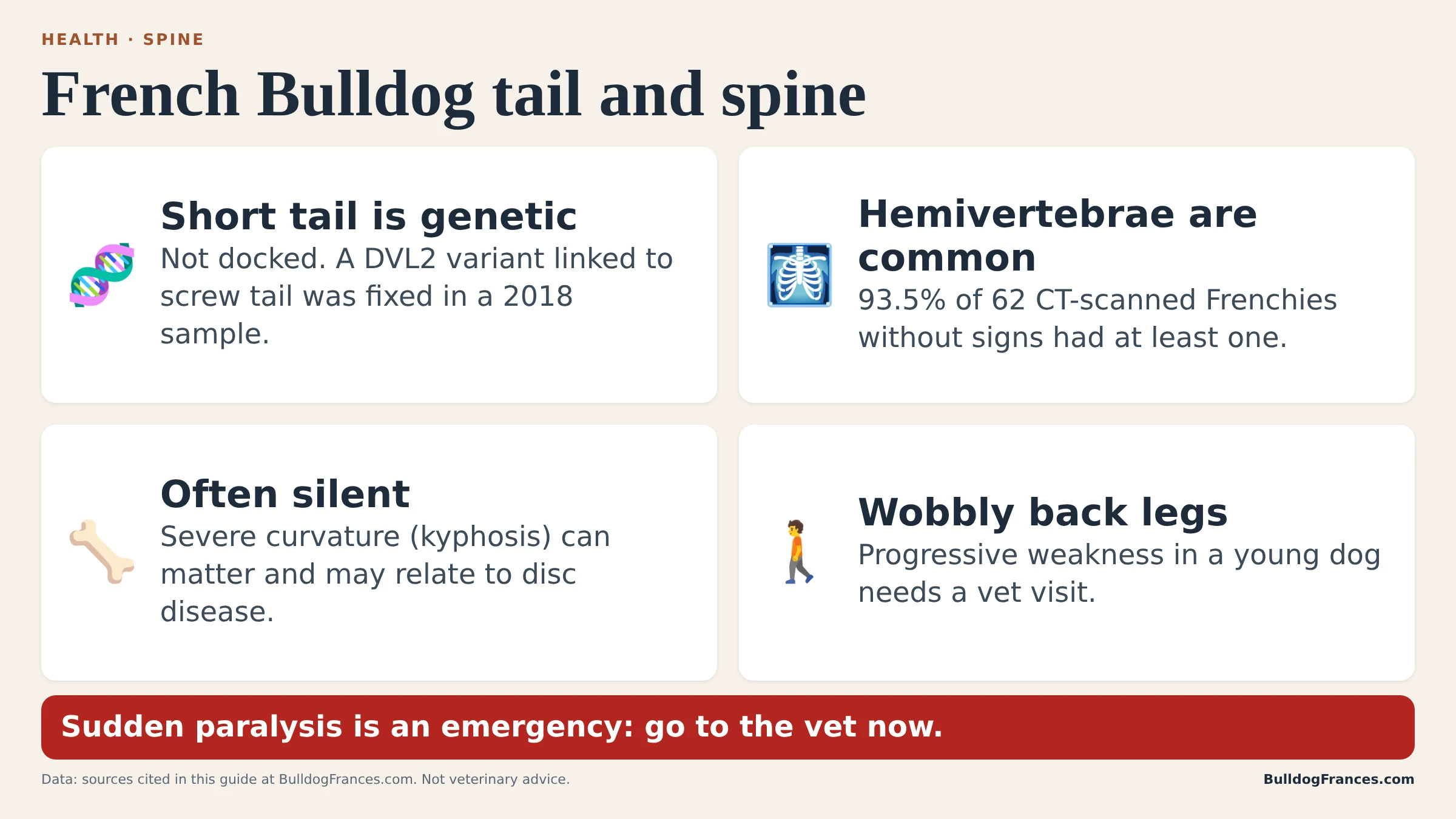
French Bulldog hemivertebrae are congenital vertebral malformations that may cause no symptoms or, sometimes, contribute to spinal problems. A screw tail alone cannot diagnose spinal cord disease.[3]
Do French Bulldogs have tails?
Yes. French Bulldogs are born with a naturally short tail; it is not cut or docked. The AKC breed standard describes it as "either straight or screwed (but not curly), short, hung low, thick root and fine tip."[4] So both a short straight tail and a kinked "corkscrew" tail fit the standard.
The short, kinked tail has a known genetic basis. A 2018 study found a variant in the DVL2 gene that was the strongest genetic match for screw tail. Researchers reported the variant as fixed in French Bulldogs and English Bulldogs in the dogs they studied, and at high allele frequency in Boston Terriers. The variant was associated with the screw-tail phenotype in the examined dogs.[1] The genetic association helps explain linked traits; tail shape alone does not show whether the spinal cord is compressed.
What are hemivertebrae?
A hemivertebra literally means "half vertebra": one of the bones of the spine does not form completely.[3] Merck lists hemivertebrae alongside block vertebrae (fused bones) and butterfly vertebrae (split bones), and notes that hemivertebrae are "most common in screw-tailed dog breeds."[5]
Because the bone is only partly formed, the spine can bend at that point, most often into a hump called kyphosis.[3]
How common are French Bulldog hemivertebrae?
A 2017 retrospective study reviewed CT scans of 62 French Bulldogs without neurological signs that had been scanned for unrelated reasons:[2]
- 93.5% had at least one hemivertebra; the sample was not a random survey of all French Bulldogs.
- The middle of the chest (the 9th and 10th thoracic vertebrae) was most often affected.
- Among 10 neurologically affected dogs selected for that study, one was a French Bulldog and nine were Pugs. Those counts cannot establish breed-wide lifetime risks.
A separate prospective German study of 265 brachycephalic dogs, including 199 French Bulldogs, found an association between severe tail malformations and vertebral malformations elsewhere in the spine. Tail shape by itself is not a diagnostic test.[6]
The Royal Veterinary College sums it up: in French Bulldogs, hemivertebrae with kyphosis usually do not cause signs, but they "should not be considered an innocent and benign condition." The curve slightly changes how these dogs walk and increases their risk of disc disease in the mid-back (IVDD), which is "by far the most common spinal disorder in French bulldogs."[3]
Hemivertebrae symptoms in French Bulldogs
When a malformation does press on the spinal cord, the RVC describes "progressive paresis and ataxia of the pelvic limbs" (gradually worsening weakness and wobbliness in the back legs), typically starting early in life.[7] In a selected referral-center group of 343 French Bulldogs with confirmed neurological disorders, 19 had a compressive vertebral malformation. Seventeen of those 19 had hemivertebrae, usually accompanied by severe kyphosis. These figures do not measure prevalence in all French Bulldogs.[8] Watch for:
- A young dog that walks more clumsily, crosses or drags its back feet, or scuffs its nails
- Back legs that get weaker over weeks or months
- A visible hump in the back
- Loss of bladder or bowel control
Emergency: sudden paralysis, inability to stand or dragging the back legs needs immediate veterinary assessment. IVDD is a common cause of sudden painful spinal signs in French Bulldogs, but the cause cannot be determined at home. The treating veterinarian decides which imaging is appropriate.[3] See back pain and weak legs in French Bulldogs.
Diagnosis: hemivertebrae on X-ray, CT and MRI
Most vertebral malformations are visible on ordinary X-rays.[9] They are often found by chance: in one CT study, almost all French Bulldogs scanned for other reasons had at least one.[2] A malformation seen on imaging does not, by itself, call for treatment.[9]
- CT shows bone shape in detail and helps a surgeon judge whether a defect can be corrected.[5]
- MRI is used when a dog has neurological signs, to see whether and where the spinal cord is compressed.[9]
The hardest part is deciding whether a malformation is relevant. The RVC notes it is "challenging to differentiate between clinically relevant and irrelevant vertebral malformations,"[3] so a neurological exam matters as much as the images.
Hemivertebrae treatment and surgery
An incidental hemivertebra finding without signs does not automatically mean surgery is necessary. A veterinarian should interpret imaging and advise on activity and follow-up. Our guide to French Bulldogs and stairs covers the evidence on jumping and stairs.
Some clinically significant vertebral malformations with progressive spinal cord signs may warrant specialist surgery; RVC reports encouraging outcomes in selected surgically treated cases, not a general success rate for all French Bulldogs.[7] The choice between monitoring, supportive care and surgery depends on neurological examination and imaging. Ask a veterinary neurologist or surgeon whether rehabilitation is appropriate for the individual dog.
Other French Bulldog tail problems
A tightly screwed tail often sits in a deep skin fold, the "tail pocket," which can trap moisture and get infected. Redness, smell or your dog scooting or licking the area are reasons to check it. Our guide to the French Bulldog tail pocket explains cleaning and when to see a vet. Researchers have proposed considering severe tail malformations in breeding decisions, but tail appearance cannot replace individual health assessment.[6]
Sources and references
- Mansour TA, Lucot K, Konopelski SE, Dickinson PJ, Sturges BK, Vernau KL, et al. Whole genome variant association across 100 dogs identifies a frame shift mutation in DISHEVELLED 2 which contributes to Robinow-like syndrome in Bulldogs and related screw tail dog breeds. PLoS Genetics. 2018;14(12):e1007850. doi:10.1371/journal.pgen.1007850.
- Ryan R, Gutierrez-Quintana R, ter Haar G, De Decker S. Prevalence of thoracic vertebral malformations in French bulldogs, Pugs and English bulldogs with and without associated neurological deficits. The Veterinary Journal. 2017;221:25-29. doi:10.1016/j.tvjl.2017.01.018. Restricted access.
- Royal Veterinary College. Neurology [Internet]. RVC Research Focus: Brachycephaly; [date unknown] [cited 2026 Nov 3].
- American Kennel Club. Official Standard of the French Bulldog [Internet]. AKC; 2018 Apr 10 [cited 2026 Nov 3].
- Packer RA. Congenital and Inherited Disorders of the Nervous System in Dogs [Internet]. Merck Veterinary Manual (Dog Owners version); 2018 Feb [updated 2026 Jul; cited 2026 Nov 3].
- Lackmann F, Forterre F, Brunnberg L, Loderstedt S. Epidemiological study of congenital malformations of the vertebral column in French bulldogs, English bulldogs and pugs. Veterinary Record. 2022;190(1):e509. doi:10.1002/vetr.509.
- De Decker S. RVC offers new treatment for congenital vertebral malformations [Internet]. RVC Clinical Connections; 2018 [cited 2026 Nov 3].
- Mayousse V, Desquilbet L, Jeandel A, Blot S. Prevalence of neurological disorders in French bulldog: a retrospective study of 343 cases (2002–2016). BMC Veterinary Research. 2017;13(1):212. doi:10.1186/s12917-017-1132-2.
- Kerrigan S, Robinson D. Juvenile Orthopedic Disease in Dogs and Cats, Part 2: Congenital and Neonatal Orthopedic Diseases. Today's Veterinary Practice. 2016.