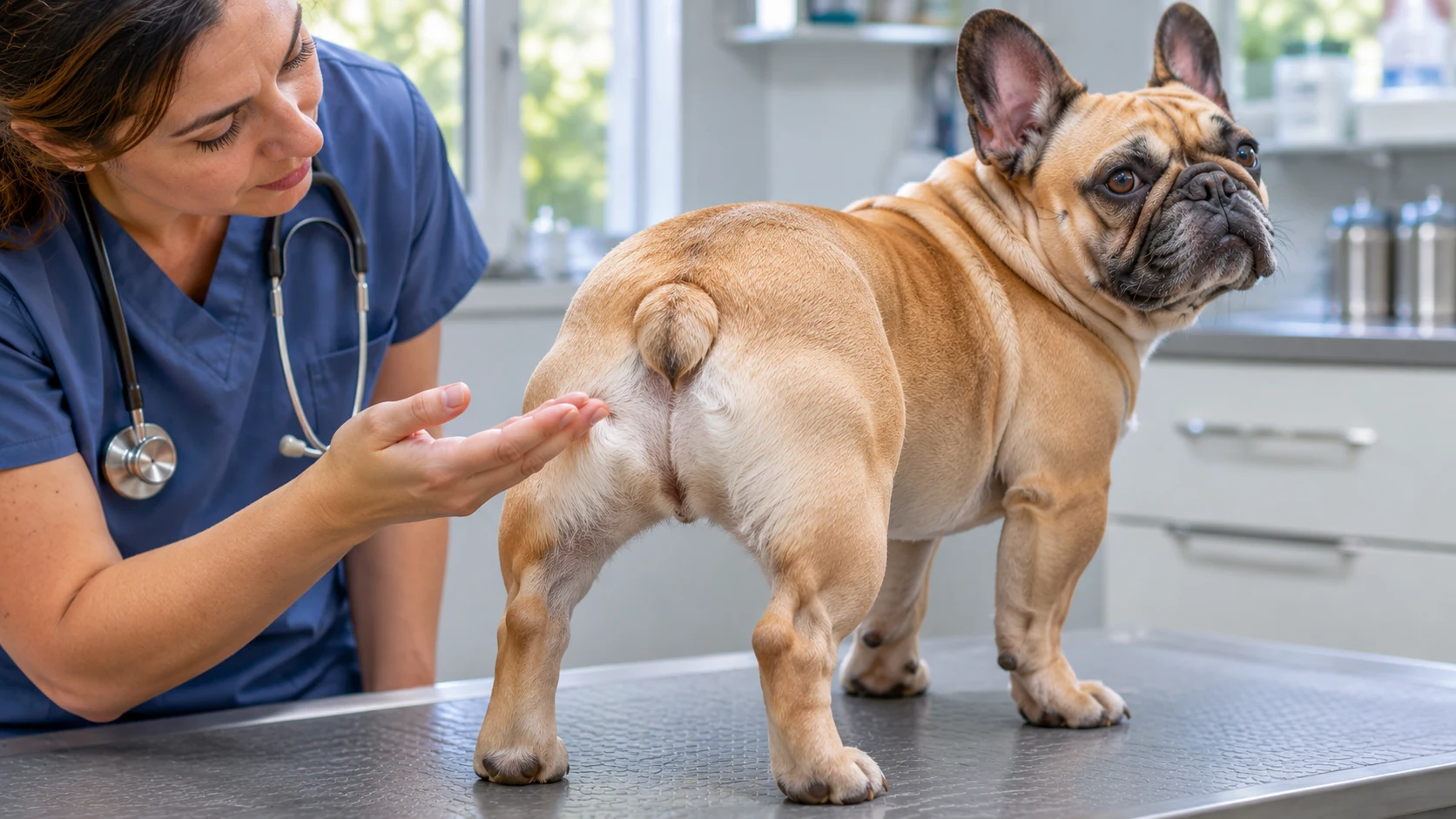
A French Bulldog tail pocket is a fold near a short, curved tail. Inspect gently for trapped moisture, odor or pain; deep folds need veterinary guidance.
What is a tail pocket?
Many French Bulldogs have short tails. In some, a tight curl or abnormal tail vertebrae create a tucked skin fold around the tail base. A tail pocket can be hidden, but not all short tails form one. Deep folds tend to trap moisture, and skin rubbing against skin gets irritated. Vets call this tail fold intertrigo.[3]
Skin fold problems are common in the breed. A Royal Veterinary College study of 2,781 French Bulldogs reported an adjusted odds ratio (aOR) of 11.18 for skin fold dermatitis of any location compared with other dogs (95% confidence interval 7.19–17.40).[1] This is a comparison of odds, not an 11-fold individual probability, and the study did not isolate tail fold disease from other skin folds.
Important distinction: a visible short tail alone is not proof of an infected pocket. Diagnosis depends on a physical examination; some dogs need imaging of the vertebrae or testing for infection.[2]
Signs of infection
Check the fold if you notice any of these signs:[2][3]
- A bad smell from the base of the tail
- Stool building up in the fold
- Itching, licking or chewing at the tail
- Discomfort when the tail area is touched
- Scooting along the floor
How to check and clean it
- Pick a calm moment, like after a walk, and have treats ready.
- Lift the skin gently around the tail. Do not pull on the tail itself.
- Inspect only what you can see comfortably. Look for irritation, trapped material, moisture, unusual discharge or a strong odor. Normal skin color varies among dogs.
- Do not force a painful or inaccessible fold. Ask your vet to demonstrate safe cleaning if it cannot be reached gently.
- Clean only an accessible, comfortable fold, using a soft cloth or veterinarian-approved wipe. Ask your vet to show you where to clean and what product is suitable.
- Pat the accessible skin dry gently with clean gauze or a soft dry cloth. Moisture and rubbing can contribute to skin irritation.[3]
- Reward your dog so the routine stays positive.
Cleaning frequency depends on the anatomy and condition of your dog's skin. VCA notes that dogs with difficult folds sometimes require cleaning after bowel movements and ongoing treatment.[2] Ask your veterinarian to set a routine for your dog; excessive rubbing or probing may hurt already inflamed skin.
What not to use
Do not apply products in a deep or painful fold without veterinary guidance, including:
- Rubbing alcohol or hydrogen peroxide
- Essential oils
- Human creams or ointments, for example with steroids or zinc
- Baby powder or cornstarch packed into the fold
When to see a vet
Arrange a veterinary assessment for foul odor, persistent redness, discharge, repeated scooting or tenderness. Seek prompt care for marked pain, a bleeding wound, trouble passing stool or a dog that will not tolerate touching the area. Never force open a tightly curled tail or push swabs into a hidden fold. Your veterinarian can determine whether there is infection, tail anatomy that blocks hygiene, or another problem.[2][3]
VCA describes ongoing medical management and surgical correction for recurrent tail-fold disease.[2] MSPCA-Angell discusses surgery to remove obstructing abnormal tail structures and affected skin folds for selected patients; neither source proves that surgery is necessary or always curative for every French Bulldog.[3]
Scooting: tail pocket or anal glands?
Scooting is not specific to tail-pocket disease. Anal-sac problems and other causes of irritation may also make dogs drag their hind end. Tell the veterinarian where your dog licks or rubs, and whether there is odor or fecal contamination. Do not diagnose or squeeze anal sacs yourself.
What your veterinarian can check and how to prepare
If routine care is uncomfortable or skin problems return quickly, describe the pattern instead of trying harder to scrub the area. Note when the odor or irritation began, whether you can see fecal residue or discharge, and whether your dog tries to bite or move away when the tail is touched. These details help your veterinarian assess the severity without the owner repeatedly manipulating a painful fold.
VCA explains that a veterinarian can assess the tail's shape, the depth of the surrounding fold, and whether the skin is inflamed. Sometimes X-rays help clarify abnormal tail vertebrae. If the veterinarian suspects a bacterial infection, additional tests such as a culture may be useful in choosing treatment.[2] Do not assume that every odor is an infection, or that every short tail needs medication.
A deep fold that traps stool or repeatedly becomes inflamed can be difficult to manage even with careful cleaning. Some dogs are helped by a veterinarian-prescribed skin-care routine, while selected cases need discussion of surgery and its risks.[2][3] Your role is to notice changes early, avoid injuring the skin, and seek an examination if normal handling is not possible. The goal is comfort and health, not perfectly cleaning an inaccessible pocket at home.
Related French Bulldog guides
- French Bulldog Dry Nose: Hyperkeratosis, Causes and Care
- Blue French Bulldog Hair Loss: Color Dilution Alopecia Explained
Sources and references
- O'Neill DG, Packer RMA, Francis P, Church DB, Brodbelt DC, Pegram C. French Bulldogs differ to other dogs in the UK in propensity for many common disorders: a VetCompass study. Canine Medicine and Genetics. 2021;8(1):13. doi:10.1186/s40575-021-00112-3.
- Hunter T, Barnette C. Corkscrew Tails [Internet]. VCA Canada Animal Hospitals; [date unknown] [updated 2025 Apr 24; cited 2026 Nov 3].
- Pavletic MM. Tail Fold Intertrigo (Screw Tail) [Internet]. MSPCA-Angell; 2026 Feb 24 [updated 2026 Apr 1; cited 2026 Nov 3].