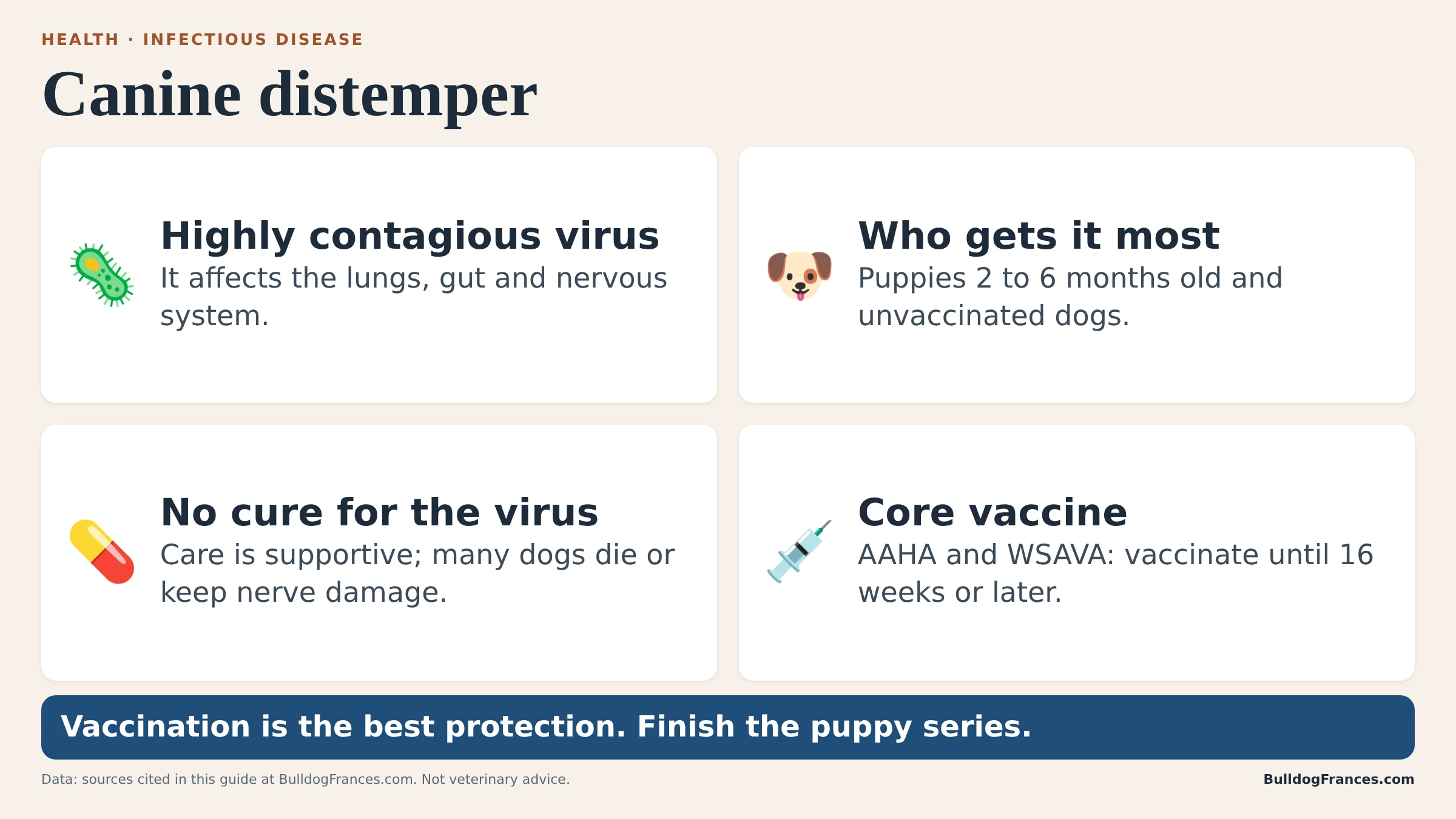
Distemper in dogs is a contagious viral disease affecting breathing, digestion and the nervous system. Core vaccinations offer strong protection, but a suspected infection requires prompt veterinary advice and isolation from other dogs.[4]
How do dogs get distemper?
The virus spreads mainly through the air, in droplets from a sick dog's coughing, sneezing or barking, and also through saliva, urine and feces.[4] Two things make it hard to contain:
- Dogs can spread the virus for several days before they look sick.[4]
- Shedding usually lasts about a month, and some dogs with nervous-system signs shed for 6 to 8 months.[4] Dogs can keep shedding even after they seem to have recovered.[1]
In the US, wildlife matters too. Raccoons, skunks, foxes, coyotes, wolves and ferrets can carry distemper, and pet dogs can catch it from them.[2] The AVMA advises discouraging contact between your dog and wildlife.[2]
Distemper in dogs symptoms timeline
Distemper doesn't follow an exact calendar, but it tends to move through these stages:
| When | What you may see |
|---|---|
| 3 to 6 days after infection | A short first fever.[1] |
| Early illness (signs often appear about 5 to 7 days after infection)[3] | Eye discharge (often the first sign), fever of 103 to 105 °F (39.5 to 41 °C), runny nose, lethargy, poor appetite.[2][3] |
| Respiratory and digestive stage | A cough that can turn from dry to wet if pneumonia develops, vomiting and diarrhea.[3] |
| Skin | Thickened, hardened footpads and nose ("hardpad disease").[1] |
| Weeks later (or 1 to 3 weeks after acute signs) | Muscle twitching, "chewing-gum" seizures, head tilt, circling, or paralysis starting in the hind legs. Once these appear, the outlook gets worse.[1][6] |
Distemper teeth: puppies that survive can be left with permanently pitted, discolored adult teeth from damaged enamel.[3]
Keep perspective: a single runny eye doesn't mean distemper. The AVMA notes that a weepy eye alone doesn't confirm the disease.[2] What should worry you is the combination of eye and nose discharge, fever and lethargy in a puppy that hasn't finished its shots. That is a same-day vet visit. Seizures are an emergency.
Can dogs survive distemper? Treatment
Some do. Not every infection is severe: the World Organisation for Animal Health notes that about half of infections in dogs and their wild relatives are mild or show no signs.[6] But the AVMA calls distemper "often fatal," and dogs that recover can have permanent nervous-system damage.[2]
There is no drug that kills the virus, and Cornell says antivirals are not recommended.[2][4] Treatment is supportive, for example:
- IV fluids for dehydration
- Antibiotics for secondary bacterial infections such as pneumonia
- Medicines to control vomiting and seizures
- Nutrition support
For dogs with severe, progressive disease, euthanasia may be discussed.[4] Don't try to wait it out at home, and be wary of "miracle cures" sold online. If you suspect distemper, keep your dog apart from other dogs and call the clinic before you arrive so staff can protect other patients.
Distemper vaccine schedule
Distemper is part of a core combination vaccine, often called DHPP or DAPP in the US (distemper, adenovirus and parvovirus, sometimes with parainfluenza).[5] The 2022 AAHA and 2024 WSAVA guidelines offer slightly different schedules; use the plan selected by your veterinarian:[7][5]
- Puppies: begin around 6–8 weeks, then repeat every 2–4 weeks with a final primary-series dose at 16 weeks or later. AAHA lists at least three typical doses; WSAVA prioritizes the age of the final dose.[5] WSAVA stresses that the last puppy dose should be at 16 weeks or older.[7]
- Follow-up: AAHA recommends a booster within a year after the puppy series.[5] WSAVA suggests giving it earlier, at or after 26 weeks.[7]
- Adults: after primary immunization, core revaccination is generally no more frequent than every three years, subject to the product license and veterinary advice.[5]
- Previously unvaccinated adults: AAHA lists two combination doses 2–4 weeks apart; WSAVA notes that one modified-live core dose is sufficient for most adults. The veterinarian should select the protocol based on vaccine and history.[7]
Why so many puppy shots? Antibodies from the mother block the vaccine during the first weeks of life, and no one can predict exactly when they fade in a given puppy.[7] The series covers that window.
Until the series is done, avoid places with lots of unknown dogs, but don't skip socialization; it matters just as much at this age. Our puppy socialization guide shows how to do it safely, and the French Bulldog puppy health checklist covers what to confirm about vaccines when you pick up your puppy.
Is distemper contagious to humans or cats?
Humans: no. Canine distemper does not infect people.[3]
Cats: pet cats get a different disease often called "feline distemper" (panleukopenia), which is caused by feline parvovirus. The AVMA warns it is not to be confused with canine distemper.[8] Canine distemper does infect wild animals, including raccoons, skunks and ferrets.[2]
After a case of distemper at home
The virus doesn't last long outside the body, usually no more than a few days, though it survives longer in cold conditions.[3][6] Clean bedding, bowls and surfaces using a pet-area disinfectant according to its label and veterinary guidance; never mix cleaning chemicals. Cornell recommends gloves and handwashing, and keeping recovering dogs away from public spaces until veterinary clearance.[4] Before bringing a new dog home, make sure it is fully vaccinated and ask your vet about timing. For a related respiratory illness, see kennel cough in dogs.
Sources and references
- Roman N. Canine Distemper (Hardpad Disease) [Internet]. Merck Veterinary Manual; 2026 Jun [cited 2026 Nov 3].
- American Veterinary Medical Association. Canine Distemper [Internet]. AVMA; [date unknown] [cited 2026 Nov 3].
- Evason M, Stull J. Canine Distemper: Information for Dog Owners [Internet]. AKC Canine Health Foundation; 2016 Sep [cited 2026 Nov 3].
- Cornell University College of Veterinary Medicine, Cornell Richard P. Riney Canine Health Center. Canine distemper virus [Internet]. Cornell Riney Canine Health Center; [date unknown] [cited 2026 Nov 3].
- American Animal Hospital Association. Recommendations for core and noncore canine vaccines [Internet]. 2022 AAHA Canine Vaccination Guidelines; 2022 [cited 2026 Nov 3].
- Bucko M, Gieger S. Morbilliviruses (Canine and Feline) [Internet]. WOAH Technical Disease Cards; [date unknown] [updated 2019; cited 2026 Nov 3].
- WSAVA Vaccination Guidelines Group. 2024 Guidelines for the Vaccination of Dogs and Cats: Executive Summary [Internet]. WSAVA; 2024 [cited 2026 Nov 3].
- American Veterinary Medical Association. Feline panleukopenia [Internet]. AVMA; [date unknown] [cited 2026 Nov 3].