French Bulldog diarrhea may be mild, but blood, repeated vomiting, severe weakness or illness in a puppy needs prompt veterinary advice. If your dog collapses or cannot stand, seek emergency care now.[5][6]
French Bulldog Diarrhea: Is the Breed More Prone?
A 2016 UK VetCompass sample compared 2,781 French Bulldogs with 21,850 other dogs. Recorded diarrhea affected 3.8% in each group; the adjusted odds ratio was 0.82 (95% CI 0.66–1.02, p=0.070), which did not establish a statistically significant difference. These UK results should not be interpreted as a lifetime prediction for an individual dog or as US prevalence.[1]
The same study separately found higher adjusted odds of allergic skin disorder (7.68) and recorded food hypersensitivity (6.96). Those findings do not mean an individual episode of diarrhea is caused by allergy. Recurrent digestive signs warrant veterinary evaluation rather than assuming a food allergy.[1]
Common causes
VCA Animal Hospitals lists these common causes of diarrhea in dogs:[3]
- Changes in diet or food intolerance[3]
- Dietary indiscretion: eating garbage or other irritating materials[3]
- Infections with bacteria, viruses, coccidia or parasites such as worms (hookworms, roundworms, whipworms)[3]
- Parvovirus, a viral disease that most often affects puppies and unvaccinated adult dogs and causes bloody diarrhea[2]
- Stress, especially after travel, boarding or other changes in the environment[3]
- Colitis (inflamed colon): Merck notes these dogs "may strain to defecate and may pass mucus-laden feces, sometimes containing blood."[2]
VCA adds that diarrhea can also be a sign of a more serious problem, such as food allergies.[3]
When to see a vet
- Diarrhea that persists beyond 48 hours, or worsens earlier; do not wait for this threshold if other warning signs occur.[5]
- Your dog is a puppy, a senior, or has other health problems
- Diarrhea comes with vomiting. Merck advises a detailed exam when vomiting is frequent or comes with other signs.[4]
- Your dog is eating less, losing weight or seems tired
- Soft stools keep coming back
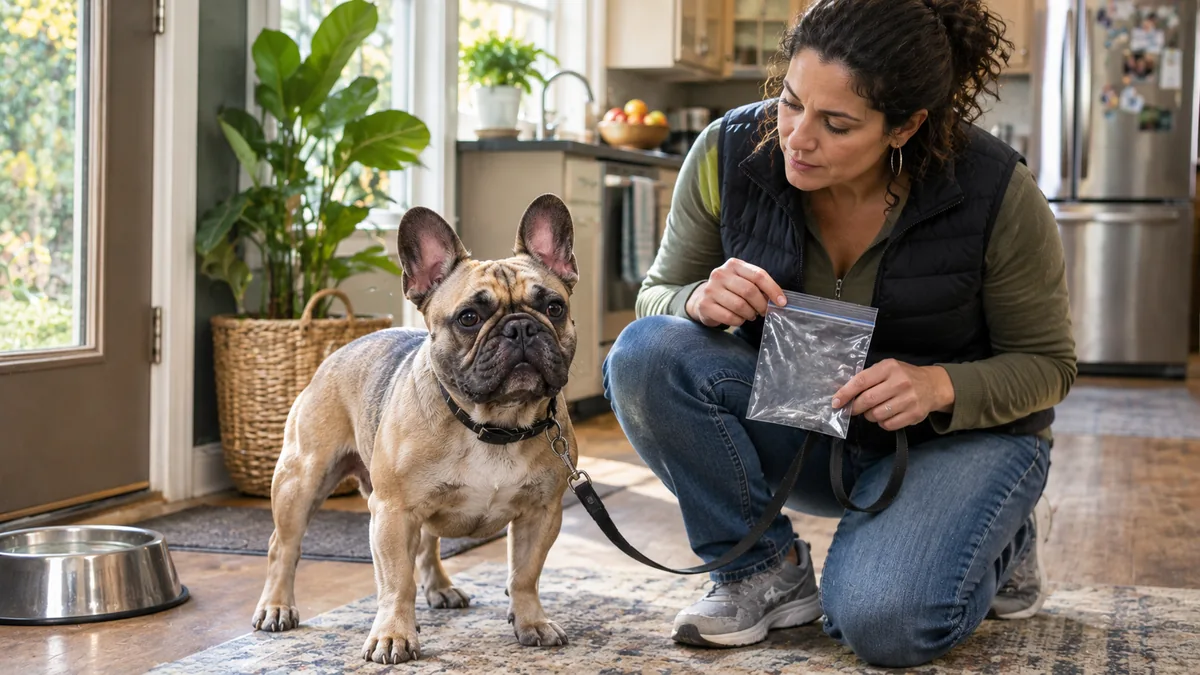
Ask your clinic whether to bring a fresh stool sample; it can help with parasite testing or other diagnostic work.[5]
Emergency Signs: When to Go Now
Seek an emergency veterinary hospital immediately for collapse, inability to stand or other signs of severe illness. Blood in stool, repeated vomiting, loss of appetite or repeated watery diarrhea also require prompt veterinary contact and may need urgent care.[6]
- Bloody diarrhea with vomiting. Acute hemorrhagic diarrhea can become severe and may require urgent fluid treatment.[2][6]
- Black, tarry stools or visible blood in the stool: contact a veterinarian promptly.[5]
- Belly pain, which Merck notes can be a sign of a blockage that "requires emergency treatment"[2]
- Severe weakness, collapse, inability to stand or pale gums: emergency evaluation is needed now.[6]
- An unvaccinated puppy with diarrhea and vomiting: seek urgent veterinary assessment because parvovirus is among the possible causes; do not diagnose it from symptoms alone.[2]
Home care for mild cases
For an adult dog that is bright, eating and drinking, with no other signs:
- Make sure fresh water is always available.
- Ask your veterinarian whether a digestible temporary diet is appropriate; do not restrict a puppy's food without veterinary guidance.[5]
- Do not give human anti-diarrhea medicines without veterinary direction; some can harm dogs or interact with other treatments.[5]
- Avoid excessive treats, rich foods and new chews during recovery.[5]
- Return to the normal diet gradually.
Preventing it
- Make diet changes gradually, following feeding instructions from your veterinarian or the food manufacturer.
- Limit extra treats and table scraps; ask your veterinary team about suitable portions.
- Do not feed fatty table scraps.
- Keep up with deworming and vaccines.
- Secure trash cans and keep toys that can be chewed into pieces away from your dog.
- If diarrhea keeps coming back, ask for a veterinary workup before starting a restrictive food trial.
Related French Bulldog guides
- French Bulldog Vomiting: Causes and Warning Signs
- French Bulldog Puppy Health Checklist: What to Check Before You Buy
Sources and references
- O'Neill DG, Packer RMA, Francis P, Church DB, Brodbelt DC, Pegram C. French Bulldogs differ to other dogs in the UK in propensity for many common disorders: a VetCompass study. Canine Medicine and Genetics. 2021;8(1):13. doi:10.1186/s40575-021-00112-3.
- Defarges A, Blois S, Hall EJ, Gibson TWG, Mitchell KD. Disorders of the Stomach and Intestines in Dogs [Internet]. Merck Veterinary Manual (Dog Owners version); 2018 May [updated 2026 Jun; cited 2026 Nov 3].
- Barnes C, Llera R, Williams K, Ward E. Diarrhea in Dogs [Internet]. VCA Animal Hospitals; [date unknown] [updated 2026 Jul 3; cited 2026 Nov 3].
- Webb CB. Vomiting in Dogs [Internet]. Merck Veterinary Manual (Dog Owners version); 2018 May [updated 2024 Sep; cited 2026 Nov 3].
- Cornell University College of Veterinary Medicine, Riney Canine Health Center. Diarrhea [Internet]. Cornell University; updated 2024 Mar [cited 2026 Nov 12].
- VCA Animal Hospitals Urgent Care. Diarrhea or Vomiting [Internet]. VCA Animal Hospitals; [date unknown; cited 2026 Nov 12].
Last reviewed November 12, 2026. Educational information only. This guide does not replace advice from your veterinarian.