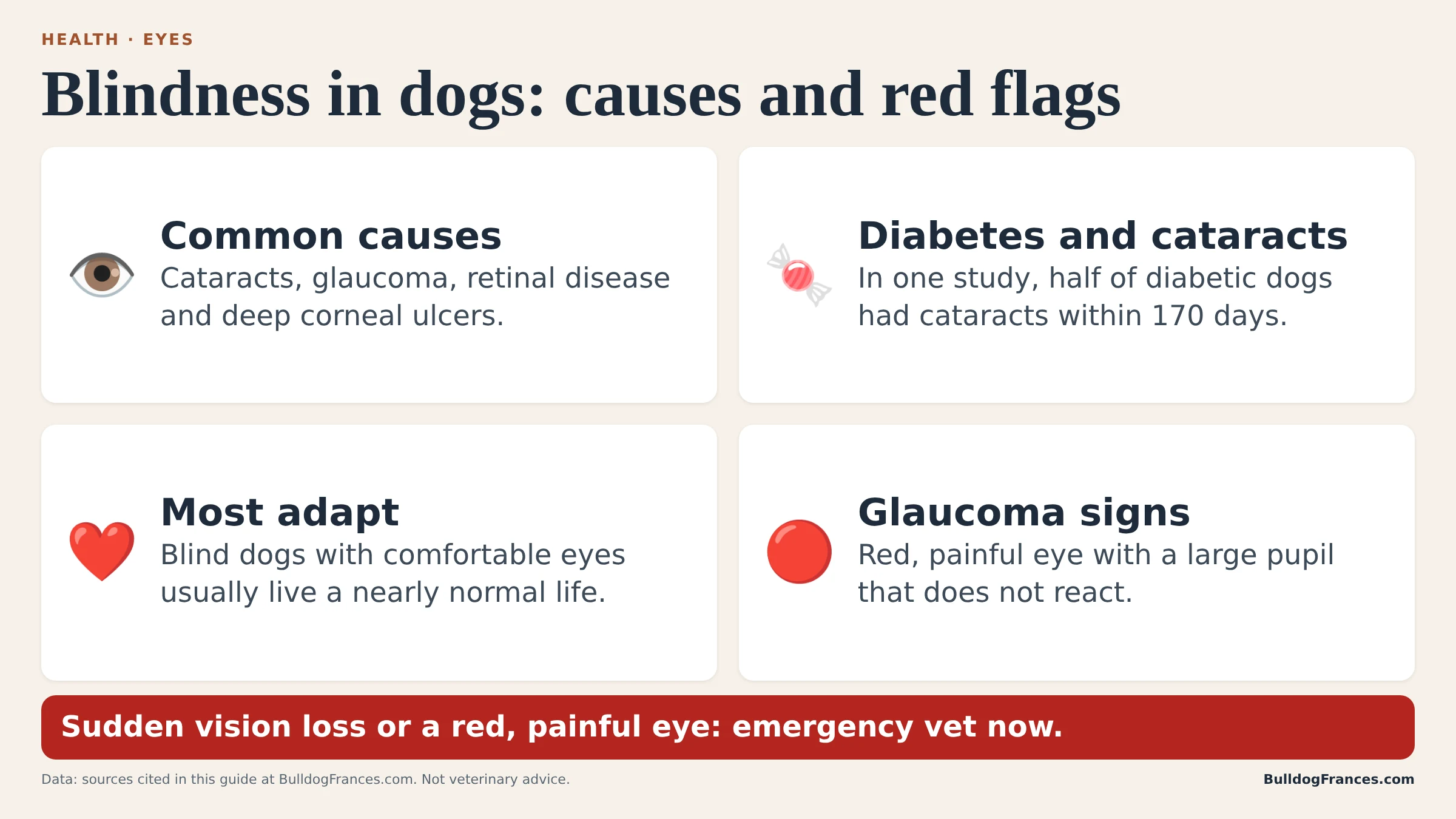
Blindness in dogs can come on over months or almost overnight. Some causes, like acute glaucoma, are emergencies where fast treatment can save the eye; others, like inherited retinal disease, progress slowly, and most dogs adapt better than their owners expect. This guide covers the early signs, the main causes, when sudden blindness is urgent, what can be reversed, and how to set up your home for a blind dog.
Signs your dog is going blind
VCA describes early signs that are easy to miss:[9]
- Anxiety or clinginess in new places
- Hesitating on stairs or before jumping on or off furniture
- Slower walks and less play
- Startling easily, sometimes with a defensive snap
- No longer making eye contact
With progressive retinal atrophy, the first sign is usually poor vision at night or in dim rooms.[4] Bumping into furniture may not show up until blindness is complete, because dogs memorize their home. Some of these signs also overlap with arthritis or canine cognitive decline.[9]
Home observations are not an eye exam. Notice whether your dog hesitates in dim light, misses moving objects or bumps into things, but do not wait for a home test before seeking care for sudden visual changes, pain or a cloudy eye.[9][11]
Blindness in dogs: causes
| Cause | What it is | How it shows up |
|---|---|---|
| Cataracts | The lens turns cloudy. Often inherited; also from diabetes, inflammation or injury.[3] | Usually gradual; can be fast in diabetic dogs.[7] |
| Glaucoma | Abnormally high pressure inside the eye that can damage the optic nerve and cause irreversible vision loss.[1] | An acute attack is painful and an emergency; chronic disease can progress more gradually and still threaten vision.[2] |
| Progressive retinal atrophy (PRA) | Inherited, painless degeneration of the retina.[4] | Starts with night blindness; full vision loss usually takes 1 to 2 years.[4] |
| SARDS | Sudden acquired retinal degeneration syndrome, most common in middle-aged to older dogs.[5] | Vision lost over several days, sometimes with more thirst, appetite and weight gain.[5] |
| Corneal ulcers | Deep erosions of the clear front of the eye that can perforate it.[6] | Squinting, a closed eye, discharge and a cloudy spot.[6] |
Short-nosed breeds are especially prone to corneal ulcers: in a study of over 100,000 UK dogs, brachycephalic breeds had about 11 times the odds of mixed breeds.[10] For breed-specific risks such as inherited juvenile cataracts, see French Bulldog going blind, and for squinting or redness, French Bulldog red eyes.
Sudden blindness in dogs: when it's urgent
Go to an emergency veterinarian immediately if you see eye pain, sudden vision loss, redness with squinting, an abnormally dilated pupil or a hazy cornea. Do not press on the eyeball to test pressure yourself. The Merck Veterinary Manual says any dog with signs of glaucoma should be seen right away, because it is a common cause of irreversible blindness.[1][2]
Sudden blindness without pain is urgent too. Acute (sudden) blindness in dogs can come from retinal detachment, SARDS, optic nerve disease or toxicity, and your vet needs to sort these out quickly. If the retina looks normal, referral to a veterinary ophthalmologist is usually the next step.[11]
In a small experimental study of 26 dogs, pressure from a collar increased intraocular pressure, whereas a harness did not cause a statistically significant increase. This does not show that harnesses prevent blindness, but it supports discussing collar alternatives with a veterinary ophthalmologist.[12]
Blindness in dogs with diabetes and in old age
Diabetes: cataracts may develop quickly. In one retrospective cohort of 200 diabetic dogs referred to a university hospital, the estimated proportions developing cataracts were 50% by 170 days, 75% by 370 days and 80% by 470 days after diagnosis. These figures are from a selected historical cohort, not a forecast for every dog.[7] If your dog is diagnosed with diabetes, ask your vet about regular eye checks and whether a referral to an ophthalmologist makes sense early.
Old age: not every cloudy eye in a senior dog is a cataract. With age, the center of the lens thickens and hardens (nuclear sclerosis), a normal change that should not be confused with a cataract.[3] Older dogs are, however, the usual age group for SARDS, and late-onset PRA typically appears around 3 to 9 years.[4][5] More on aging eyes and bodies in our senior French Bulldog care guide.
Treatment: can blindness in dogs be reversed?
It depends on the cause:
- Cataracts: surgery is the treatment, and it is most likely to succeed when done before the cataract is fully mature. Untreated cataracts still need monitoring, because complications such as glaucoma can develop.[3]
- Acute glaucoma: emergency treatment aims to lower the eye pressure fast and preserve as much vision as possible, so early diagnosis is critical.[2]
- PRA and SARDS: no effective treatment has been reported, and antioxidant supplements have shown no measurable benefit for PRA.[4][5]
- Deep corneal ulcers: need prompt treatment to save the eye.[6]
Living with a blind dog
The American College of Veterinary Ophthalmologists (ACVO) says that if the eyes aren't painful, most pets adapt well using smell and hearing, some within weeks and some almost at once, and that "blindness is often harder on the pet owner than it is on the animal."[8] Its tips:[8]
- Keep furniture where it is and set up a fixed "home base" with water, food and bed.
- Gate off stairs and drops, and keep your dog away from pools.
- Use noisy or scented toys, and rugs with different textures as landmarks.
- Put a bell on your other pets.
- Speak before you touch, and teach cues like "stop" and "step."
- Use a leash in unfamiliar places.
- Keep checking the eyes: a blind eye can still hurt or get infected.
Stairs are the biggest household hazard for a dog losing its sight; our French Bulldog stairs guide has setup ideas.
Sources and references
- Gelatt KN. Glaucoma in Dogs [Internet]. Merck Veterinary Manual; 2018 Jun [updated 2024 Sep; cited 2026 Nov 3].
- Thomasy SM. Acute Glaucoma in Small Animals [Internet]. Merck Veterinary Manual; 2024 Jul [cited 2026 Nov 3].
- Gelatt KN. Disorders of the Lens in Dogs [Internet]. Merck Veterinary Manual (Dog Owners version); 2018 Jun [updated 2026 Apr; cited 2026 Nov 3].
- Hunter T, Llera R, Yuill C. Progressive Retinal Atrophy in Dogs [Internet]. VCA Animal Hospitals; [date unknown] [updated 2023 Nov 29; cited 2026 Nov 3].
- Thomasy SM. Sudden Acquired Retinal Degeneration Syndrome in Dogs [Internet]. Merck Veterinary Manual; 2024 Jul [updated 2024 Aug; cited 2026 Nov 3].
- Barnes C, Weir M, Ward E. Corneal Ulcers in Dogs [Internet]. VCA Animal Hospitals; [date unknown] [updated 2025 Jul 25; cited 2026 Nov 3].
- Beam S, Correa MT, Davidson MG. A retrospective-cohort study on the development of cataracts in dogs with diabetes mellitus: 200 cases. Veterinary Ophthalmology. 1999;2(3):169–172. doi:10.1046/j.1463-5224.1999.00073.x.
- American College of Veterinary Ophthalmologists. Tips on Adjusting to Your Pet's Blindness [Internet]. ACVO; 2021 Dec 15 [cited 2026 Nov 3].
- VCA Animal Hospitals. Signs of vision loss in pets [Internet]. VCA Animal Hospitals; [date unknown] [cited 2026 Nov 3].
- O'Neill DG, Lee MM, Brodbelt DC, Church DB, Sanchez RF. Corneal ulcerative disease in dogs under primary veterinary care in England: epidemiology and clinical management. Canine Genetics and Epidemiology. 2017;4(1):5. doi:10.1186/s40575-017-0045-5.
- Thomasy SM. Acute Vision Loss in Small Animals [Internet]. Merck Veterinary Manual; 2024 Jul [cited 2026 Nov 3].
- Pauli AM, Bentley E, Diehl KA, Miller PE. Effects of the Application of Neck Pressure by a Collar or Harness on Intraocular Pressure in Dogs. Journal of the American Animal Hospital Association. 2006;42(3):207-211. doi:10.5326/0420207.