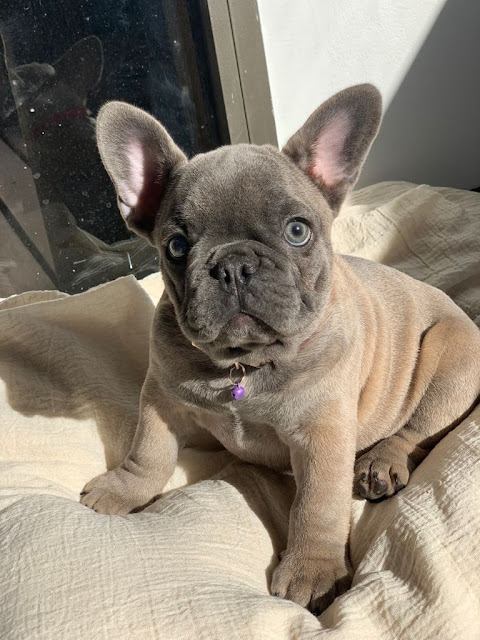
French Bulldog

The brachycephalic syndrome
Dr. Janice Durr Grebe, Ph.D
Second part

When stenotic nares, elongated soft palate, or both cause chronic airway obstruction, the increased effort to pull air into the compromised airway exerts an ongoing stress on the walls of the larynx, in effect sucking them inward.
This has two major effects:

First, it pulls inward on the laryngeal ventricles (laryngeal saccules); these little out pocketing of the thin membrane lining the larynx are located just above the vocal cords. Chronic airway obstruction everts these little membrane sacs, so instead of sticking outward, they are pulled inward and into the glottis, further clogging the already bad airway. Everted saccules not only result from chronic airway obstruction, but also aggravate the problem.
Second, prolonged airway stress that pulls inward on the laryngeal walls can distort and collapse them inward, further obstructing the airway and increasing the effort necessary to inhale air. As with the palate, increased turbulence and vibrations in the airway cause swelling and irritation of the laryngeal membranes, further worsening the situation.
Third, the trachea in brachycephalic dogs may be underdeveloped (“hypoplastic”), and may present still another obstacle in breathing. If the trachea is abnormally narrow to start with, this not only contributes to the overall obstruction and helps increase the forces that are pulling inward on the airway walls, but also makes the trachea more easily collapsed. Partial collapse of the larynx or trachea may occur, increasing the respiratory effort, stress intolerance, and overheating problems.

Any or all of the above may persist for some time, without the owner’s being aware that the airway’s condition is becoming progressively worse due to the vicious cycle of airway obstruction > airway changes > worse airway obstruction. Then, unexpectedly, the dog may have a respiratory infection that causes some swelling, or gets excited, hot or exercised once too often. And suddenly the partially collapsed larynx or trachea may totally collapse, or the everted saccules or soft palate may plug the glottis. The end result: asphyxiation, which unless the owner was aware of the problem, may be seen as “sudden death due to heart failure”.

So what is to be done?
There are two issues to be dealt with: the life and health of each individual dog, and the life and health of the breed. First, consider the individual dog. Only one part of the airway (the nares) can be evaluated with anesthetizing the dog, since there’s no way to look at the soft palate and larynx in a wide-awake Frenchie. Therefore, it’s up to the owner to observe the dog with a high index of suspicion.

* Are the nares obviously stenotic? Can you see and hear them interfering with each intake of breath?
* Does the dog make a lot of “slobbery and gurgling” noises in the mouth and throat? Snore a lot? (I know, this is almost an “unofficial part” of the breed standard).
* Does the dog frequently gag or throw up froth, for no apparent reason?
* Does the dog’s breathing become easily labored even in cool weather, or with minimal exercise or stress?
* Does the dog overheat easily, even in moderate temperatures?

If you answer ”yes” to any or all of these, your Frenchie may need further evaluation and, if indicated, surgery. A warning, though: some of the procedures used in treating this syndrome are not simple! If you have a vet with large Bulldog practice, she or he may have considerable experience with the brachycephalic syndrome, and may be perfectly competent to evaluate and treat your pet. If not, consider asking for referral either to a Vet School hospital, where there state-of-the art intensive facilities and specialists in surgery, anesthesia, and posoperative care.
If this is not available, talk to the English Bulldog people and ask who tends their dog’s airways. Many vets who feel they don’t have enough experience with brachycephalic syndrome will refer you to a colleaguewho has the necessary expertise. All Frenchie owners should have a good relationship with their vets, so that they can be frank about their concerns and their desire to obtain the very best available care for their pets, even if it means referral to another vet.

If it appears likely that there are serious airway problems, the vet must anesthetize the dog to evaluate it properly. The exam may be done under light anesthesia, but if the exam shows that surgery is needed, then the anesthesia can be deepened and the procedure done at the same time under the same anesthesia. Anesthesia carries risk for Frenchies in any event, and even more so when there is an airway problem; therefore it should be done as seldom as possible.

If the dog has stenotic nares, elongated soft palate, and everted laryngeal saccules, all should be corrected at the same surgery. Bear in mind that the procedure on the nose will alter the appearance somewhat, this may cause a dilemma if you are showing the dog. However, if the nares are responsible for a significant proportion of the obstruction, then shortening the palate and removing the saccules may not solve the problem, since the airway is only as good as its opening to the outside. If you are not showing the dog, then the minor change in the nose is a small price to pay for a healthier Frenchie.

figure 2

In shortening the palate (a procedure called staphylectomy) the vet must take special precautions to maintain an open airway during and after surgery. First, of course, the dog should have an endiotracheal tube inserted that is small enough to leave the surgeaon anough room to work in the pharynx and larynx, but large enough to provide adequate air flow. Any manipulation of the larynx can very easily cause rapid swelling that is severe enough to close the airway. Therefore, a potent short-acting anti-inflammatory drug should be given at the start of the procedure to minimize swelling during surgery.
After surgery, a long-acting anti-inflammatory is given to control swelling that may develop later. The dog should be kept sedated and not given food or water for 24 hours after surgery; fluids should be given intravenously to prevent dehydration. A drug may be given to reduce the amount of saliva that the dog secretes, to prevent choking. The endotrachial tube should not be removed until the dog is completely recovered from the anesthesia; and the patient should be kept resting on its belly as to keep its large tongue from relaxing and plugging up the throat. Close observation for a couple of days after surgery is really desirable, preferably by someone who is able to re-intubate the dog, or even do an emergency tracheostomy if necessary. (In a tracheotomy, a temporary opening is made through the front of the neck into the trachea, below the level of the larynx, and a tube is inserted here).
When the palate is shortened that it be shortened precisely the right amount. If too little is removed, it may still obstruct the airflow. If too much is cut off, not enough will be left to close off the airway during swallowing, and the dog will tend to aspirate food and water into its lungs. Bear in mind that there is no dotted line that shows the surgeon where to cut; and that if an error is made, it’s better to cut off too little than too much. It’s easier to trim off a little more tissue han to re-lengthen a too-short palate.

Removal of everted saccules (laryngeal sacculectomy) is a brief procedure, usually done at the same time as the nares and/or palate are treated, and it involves snipping the saccules out with scissors, or snaring them with a wire loop. It does not usually cause much bleeding, and it is much simpler than the palate shortening procedure. If the nares and soft palate are treated early enough, the saccules may not yet have become everted, and correction of the other problems should prevent this happening.

If stenotic nares and/or elongated soft palate have lead to partial collapse of the larynx, then correction of the palate, nares and saccules may prevent further laryngeal or tracheal collapse, and although some surgical procedures may help with certain cases, these are very complex, not always successful, and usually done only as a last resort. Some vets recommend a tracheostomy (permanent opening through the neck into the trachea) as the preferred treatment for accute laryngeal collapse. We will assume that Frenchie owners, once alerted to the problem, will have the nares and/or palate problems corrected before the collapse occurs.

A further suggestion: don’t use any type of collar on a dog with any degree of airway impairment, to avoid putting any additional stress on the trachea. Even the most ox-like Frenchie neck may conceal a fragile airway, so a well-fitted harness is much better for the dog. And at least one Frenchie (who shall be nameless) has shown that a harness may even be used for obedience-training.

What about the significance of the brachycephalic syndrome for the Breed?
The root of the problem is the short face. Some genetic studies in the English Bulldog suggest that the gene that controls the lengths of the soft palate is a different one, from the gene that controls the length of the skull, and that the overlong palate is a souvenir of the breed’s long-nosed ancestors. The root of the problem is the short face. Some genetic studies in the Bulldog suggest that the gene that controls the lengths of the soft palate is a different one, from the gene that controls the length of the skull, and that the overlong palate is a souvenir of the breed’s long-nosed ancestors.

drawing Becca Williams

If breeders would begin accumulating data about palate elongation in their lines, then when the GDCIS database is available, we can help determine whether this soft palate problem can be solved by selective breeding.
The problem is that the diagnosis requires anesthesia. Why not suggest that if any Frenchie must be anesthetized for any reason, like C-sections, minor surgery, spaying or neutering, the vet should examine the palate and the larynx at the same time? In this way, you may detect an unsuspected problem in time to prevent a serious laryngeal collapse, and also help accumulate data about the real frequency of airway problems in our breed.
If you feel that a Frenchie with a bad airway should be bred anyway, consider searching for a dog with a known good airway to breed to.
And don’t condemn Frenchies with slightly longer noses. My first Frenchie whose “pet quality” status was determined by a nose a little longer than is considered desirable (despite a perfect body, superb ears, and a great gait), has enjoyed 9 years of good health and has never had a problem with overheating or exercise intolerance. And seldom even snores.

A French Bulldog’s quality of life requires good breathing. If we all try to insure that each pup can lead an active life, and that airway problems in the breed as a whole become the exception instead of the norm, then we will all breathe easier... Frenchies and their owners alike.

From “Healthy Frenchies: an Owner´s Manual”. Published by ArDesign. USA.1998


drawing Becca Williams

Illustration by Becca Williams. USA

back